
Printmaking and graphic arts
Multiple impressions, original decisions
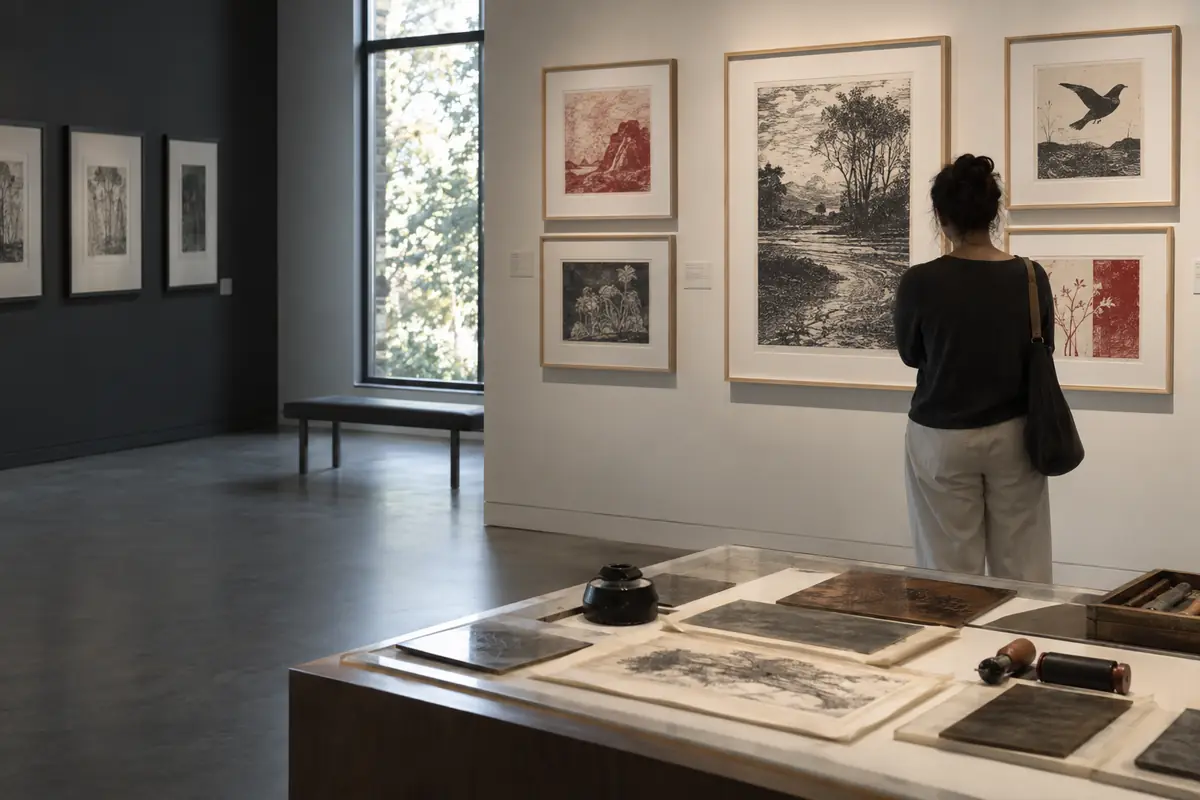
A print begins with transfer. An artist prepares a matrix, inks it and prints one or more impressions, sometimes with a specialist workshop.
An edition may vary by colour, paper, state or pressure. Edition details matter, yet texture, margins and the link between gesture and process deserve close attention too.
Art guide
Three families of process
An image moves from wood, metal, stone or screen to paper, and each process leaves distinctive traces.
Relief
In woodcut or linocut, the raised surface receives the ink.
Intaglio
Ink sits in the recessed lines of an engraved or etched plate and transfers under pressure.
Planographic and stencil
Lithography and screenprinting use different ways to control where ink reaches the sheet.
Printmaking and graphic arts
Reading an impression
- 01
Study the margins
Notice dimensions, any plate mark, signature and edition information.
- 02
Look closely
Compare lines, flat colours, layers and paper texture without touching the work.
- 03
Read the record
Check process, date, state, publisher and any workshop role.
Glossary
Print terms
Technical records help explain what the eye sees.
- Matrix
- A prepared surface carrying an image before transfer.
- Impression
- A sheet printed from a matrix.
- State
- A version made after the matrix has been altered.
Printmaking and graphic arts
Questions about prints
Understand major printmaking methods and learn how to look at a printed impression.
01Are all prints engraved?
No. Engraving is one family; lithography and screenprinting also produce prints.
02Are two impressions identical?
Not necessarily. Paper, inking, pressure and changes to the matrix can create differences.
03Is a print a reproduction?
An original print is conceived for printing; the term does not automatically mean a copy of another work.


